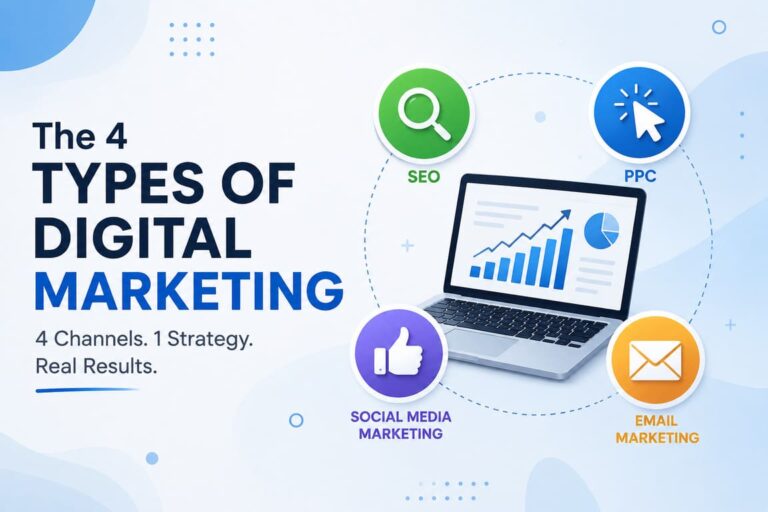
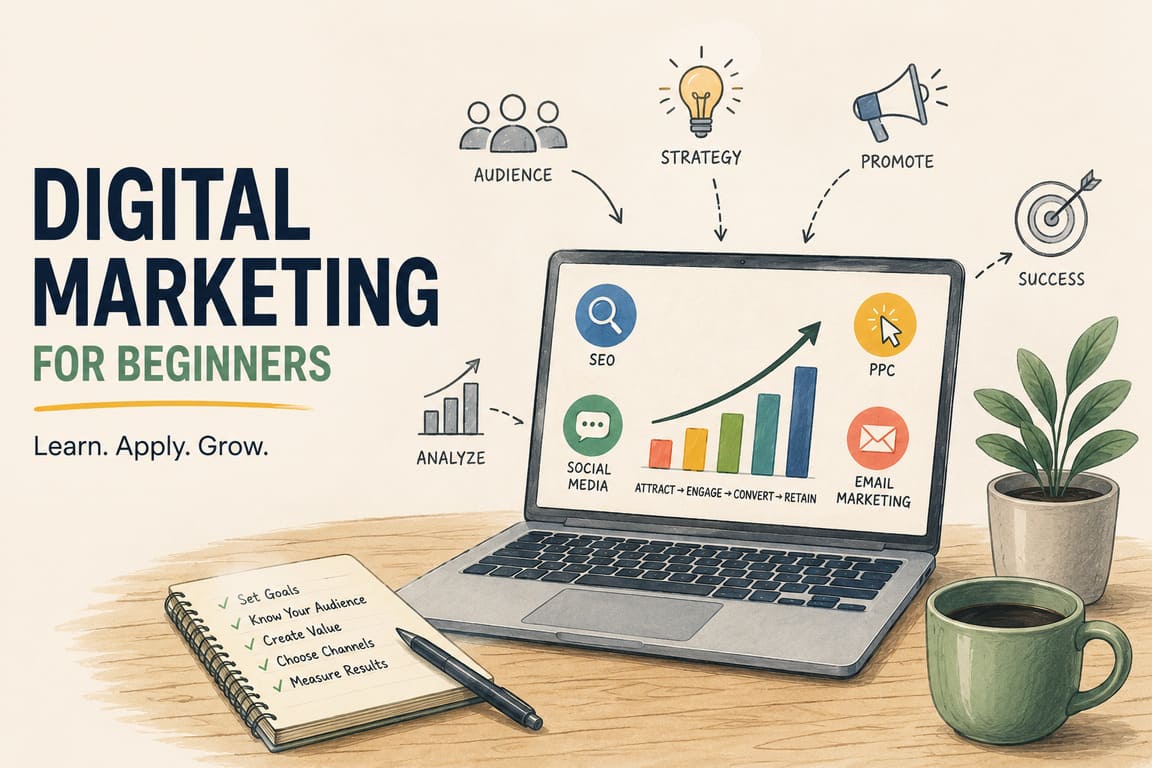
Digital marketing is simply the process of using online channels—your website, search engines, social media, email, and ads—to attract people, turn them into leads, and convert them into customers. The good news for beginners is that you do not need to master every channel at once. The smart way to start is to build a small system: one goal, one audience, one offer, and a few channels that fit that goal.
Today, digital marketing matters because your audience is already online. Global internet users have passed 6.04 billion, social media user identities stand at 5.66 billion, and unique mobile users have reached 5.78 billion. On top of that, 63% of consumers prefer to find brand and product information on mobile devices, which means beginners should think mobile-first from day one. DataReportal
The beginner mindset: start small, but start with a system
Most beginners fail because they try to “do marketing” in general. That is too broad. A better approach is:
- pick one business goal,
- pick one audience,
- create one useful offer,
- choose two or three channels,
- measure results every week.
That works because digital marketing gets easier when every action points to one clear outcome. If your goal is “get 20 qualified leads a month,” then your content, emails, ads, and landing pages all become easier to plan.
Where beginners should start first
| Goal | Best channel to start with | Why it works | First beginner action | Metric to track |
|---|---|---|---|---|
| Get found on Google | SEO + content | Brings steady traffic over time | Publish one article answering a real customer question | Organic clicks |
| Build relationships | Email marketing | You own the audience and can follow up cheaply | Create a signup form + 3-email welcome sequence | Open rate / clicks |
| Build awareness fast | Social media | Easy to publish and test messaging | Post 3 short educational posts per week | Reach / saves / profile visits |
| Get leads quickly | Google Search Ads | Captures high intent when people are already searching | Run a small campaign for one service or product | Cost per lead |
| Increase trust and conversions | Video | Explains value fast and shows personality | Record 3 short videos answering FAQs | Watch time / leads |
A simple text infographic for beginners
BEGINNER DIGITAL MARKETING SYSTEM

1) ATTRACT
   SEO content + short social posts + search ads

          ↓

2) CAPTURE
   Landing page + clear offer + email signup form

          ↓

3) NURTURE
   Helpful emails + retargeting + testimonials

          ↓

4) CONVERT
   Demo / purchase / call booking / checkout

          ↓

5) IMPROVE
   Track clicks, leads, conversion rate, and cost
This structure works because it matches the real customer journey. People first discover you, then compare options, then need reminders and proof, and only then decide. Beginners often jump straight to “buy now” without building the steps before it.
Step 1: Choose one narrow audience and one clear offer
Before you post on social media or run ads, answer these two questions:
- Who am I trying to help?
- What specific result do I help them get?
Bad example: “I market for everyone.”
Better example: “I help local fitness studios get more trial bookings.”
Bad offer: “Contact us for more info.”
Better offer: “Get a free 20-minute website and ads audit.”
This works because clear positioning improves relevance. Relevance makes your content easier to write, your ads cheaper, and your landing pages more persuasive. Google also stresses relevance in both SEO and paid search: clear content, useful pages, and keyword alignment are basic requirements for better performance.
Step 2: Build the minimum assets before you promote anything
Beginners do not need a complex funnel. You need only four core assets:
- a simple website or landing page,
- one offer,
- one email signup form,
- basic analytics and conversion tracking.
This matters because traffic without tracking is guesswork. Google recommends setting up conversion tracking early so you can see whether clicks lead to purchases, calls, signups, or other valuable actions. That is the difference between “running campaigns” and actually learning what works.
Step 3: Start with the strategies that give beginners the best learning loop
1) SEO and helpful content
SEO is one of the best channels for beginners because it teaches you how customers think. If someone searches “how to choose a wedding photographer in Chicago,” that search reveals intent, pain points, and language. Google’s beginner SEO guidance is simple: create useful people-first content, use descriptive titles and URLs, organize your site clearly, add internal links, optimize images, and avoid keyword stuffing.
Why this strategy works:
It captures demand that already exists. People are actively looking for answers, products, or services.
What results it can bring:
Over time, SEO can produce lower-cost traffic than paid ads and keep working after a post is published.
How beginners can apply it:
Start with 10 customer questions. Turn each question into one article, one FAQ block, one short video, and one email topic. Write clearly, answer the question fast, and link related pages together.
A good beginner content formula is:
- problem,
- common mistakes,
- step-by-step fix,
- example,
- call to action.
2) Email marketing
Email remains one of the most practical beginner channels because you own the list. Algorithms change. Your email list is still yours. HubSpot reports an average email click-through rate of 2.5%, and segmented emails drive 30% more opens and 50% more click-throughs than unsegmented emails. Mailchimp’s platform research also found that segmented campaigns achieved 14.31% higher opens and 100.95% higher clicks than non-segmented campaigns in its sample.
Why this strategy works:
It lets you follow up with people who are interested but not ready to buy today.
What results it can bring:
More repeat visits, more trust, more conversions, and stronger retention.
How beginners can apply it:
Mailchimp’s beginner process is simple: choose segmentation criteria, collect data, create content for each segment, then measure and test. A beginner can start with just three segments: new subscribers, interested leads, and customers.
A very simple welcome sequence:
- Email 1: who you help and what you offer
- Email 2: one useful lesson or case study
- Email 3: invitation to book a call, start a trial, or buy
3) Social media content
Social media is useful for beginners because it is fast to test. You can publish three ideas this week and see what gets attention. The mistake is trying to be on every platform. A better approach is to choose one platform where your audience already spends time.
Why this strategy works:
It gives fast feedback on topics, hooks, and messaging.
What results it can bring:
Brand awareness, profile visits, leads, and content ideas for other channels.
How beginners can apply it:
Use a 70/20/10 mix:
- 70% helpful education,
- 20% proof and case studies,
- 10% direct promotion.
Beginners should also repurpose instead of creating from scratch. One blog post can become:
- 3 LinkedIn posts,
- 1 Instagram carousel,
- 1 short video,
- 1 email.
That works because repetition across channels builds memory. Also, video-heavy social content is now mainstream: 91% of businesses use video as a marketing tool, and short-form video delivers the highest reported ROI among content formats at 49%.
4) Google Search Ads
Beginners often think ads are too advanced, but search ads can be one of the easiest paid channels to understand because they match visible buyer intent. If someone searches “emergency plumber near me,” that is very different from showing a random ad to a cold audience.
Why this strategy works:
You reach people when they are already looking for a solution.
What results it can bring:
Faster leads and sales than SEO, especially for local and service businesses.
How beginners can apply it:
Start with one service, one location, and a small list of high-intent keywords. Track conversions, review the search terms report, remove irrelevant traffic with negative keywords, and watch Quality Score and ROI. Google explicitly recommends beginners focus on conversion tracking, ROI, productive keywords, Quality Score, and reporting first.
5) Short-form video
Video is powerful because it compresses trust. People can see your face, hear your tone, and understand your offer faster. For beginners, video does not need to be cinematic. Clear is better than polished.
Why this strategy works:
It explains products and services quickly and feels more human than text alone.
What results it can bring:
Higher engagement, better trust, more saved posts, and stronger conversion support.
How beginners can apply it:
Record simple videos answering:
- the top 5 customer questions,
- the top 3 objections,
- one client story,
- one behind-the-scenes process.
If you hate being on camera, use screen recordings, voiceovers, slides, or product demos.
Statistics every beginner should know
- 6.04 billion people use the internet globally.
- 5.66 billion social media user identities are active globally.
- 5.78 billion people are unique mobile users.
- 63% of consumers prefer to find brand and product information on mobile devices.
- 91% of businesses use video as a marketing tool.
- Short-form video leads content ROI at 49%.
- The average email CTR across industries is 2.5%.
- Segmented emails drive 30% more opens and 50% more click-throughs than unsegmented emails.
These numbers matter because they show where attention already is: online, mobile, social, inbox, and video.
Real-world digital marketing examples and case studies
Dollar Shave Club: simple message, strong personality, fast traction
Dollar Shave Club’s early growth is one of the best beginner marketing lessons ever. Its first video cost about $4,500, and within 48 hours of going live, the company received 12,000 orders. The same business went on to make more than $3.5 million in revenue in 2012, and sales later topped $225 million by the time Unilever bought it. Inc.
Why it worked:
The brand had a clear audience, a clear problem, a memorable voice, and a simple offer. The video was not expensive; it was sharp and easy to share.
What beginners should copy:
Do not copy the jokes—copy the clarity. Make your offer obvious, your message memorable, and your landing page ready for traffic.
Asutra: search intent + product-market fit + paid ads
Asutra used Google tools to understand what people were searching for, spotted demand around magnesium-related products, then built Search, Shopping, and later Performance Max campaigns around that demand. The result: from almost no website visits in 2018 to 300K+ clicks in 2022, a 75% increase in Google-generated revenue in three years, and an 84% increase in ROAS plus a 27% increase in click-through rate from Performance Max in 2022.
Why it worked:
The company did not guess. It used search behavior to guide product and campaign decisions.
What beginners should copy:
Use keyword research to find what people already want. Then build pages and ads that match that exact need.
AIIM: useful content + conversion-focused funnel
AIIM improved its inbound marketing by using forms, workflows, analytics, and content offers such as ebooks and webinars. The results were strong: 4.8x more leads, 87% customer growth, and one ebook landing page converting at nearly 74%.
Why it worked:
AIIM did not just publish content. It connected content to forms, follow-up, segmentation, and sales actions.
What beginners should copy:
Every piece of content should lead somewhere: a signup, a download, a booking, or a sale.
The biggest beginner mistakes to avoid
Google’s guidance is especially clear here. Beginners should avoid keyword stuffing, relying on meta keywords, copying content, and obsessing over myths instead of usefulness. In ads, beginners should avoid sending paid traffic without conversion tracking and should review actual search terms so budget is not wasted on irrelevant clicks.
The practical list:
- Do not try every platform at once.
- Do not post content without a goal.
- Do not run ads without tracking.
- Do not write for algorithms before you write for people.
- Do not collect emails and then never send anything useful.
- Do not measure vanity metrics only; leads and sales matter more.
A 30-day beginner action plan
Week 1
- Define your audience
- Write your offer
- Set up a landing page
- Install analytics and conversion tracking
Week 2
- Publish 2 helpful articles or pages
- Create 1 lead magnet or free resource
- Build a 3-email welcome sequence
Week 3
- Publish 3 social posts from your content
- Record 2 short videos
- Start collecting emails
Week 4
- Launch a small Google Search Ads test
- Check search terms
- Improve your landing page headline and CTA
- Review leads, clicks, and conversion rate
This works because it builds owned assets first, then traffic second. That order is important.
Best professional guides for beginners
| Guide | What it teaches | Why it is useful for beginners |
|---|---|---|
| Google SEO Starter Guide | SEO basics, site structure, titles, content quality, image optimization, mistakes to avoid | Clear, practical, and written around what Google wants site owners to focus on |
| HubSpot Digital Marketing Guide | Digital marketing basics, channels, strategy, analytics, mobile marketing | Good high-level overview if you need the full map before choosing channels |
| HubSpot Marketing Statistics | Fresh benchmarks for email, video, CRO, social, and mobile | Helps beginners prioritize what is working now |
| Mailchimp Email Segmentation Guide | How to segment email lists and test campaigns | Useful for turning a basic email list into a conversion tool |
| Mailchimp Segmentation Performance Data | Open, click, unsubscribe, and abuse-rate impact of segmentation | Gives practical proof that targeted emails outperform generic blasts |
| Google Ads Analysis Guide | Conversion tracking, ROI, keywords, Quality Score, reports | Perfect for beginners who want to spend small budgets wisely |
FAQ
Do beginners need a website before starting digital marketing?
Yes. It does not need to be big, but you need one place you control where people can learn, sign up, or buy. Social platforms are rented space. Your website or landing page is owned space.
Which channel should a beginner learn first?
Start with content + email if you want long-term growth on a small budget. Start with Google Search Ads if you need leads faster and already know what you sell.
How much money should a beginner spend?
You can start organic channels with almost no ad budget. If you use paid ads, begin small and only after conversion tracking is in place. Otherwise, you will pay for traffic without learning from it.
Is SEO too slow for beginners?
SEO is slower than ads, but it teaches market demand and compounds over time. A smart beginner often combines SEO for long-term traffic with a small paid campaign for fast feedback.
How often should beginners post on social media?
Consistency matters more than volume. Three useful posts a week is better than daily low-value posts.
What should beginners measure first?
Start with:
- traffic,
- leads,
- conversion rate,
- cost per lead,
- email clicks,
- search terms,
- revenue from each channel.
Is email marketing still worth it?
Yes. It is still one of the best channels for follow-up, relationship building, and conversion, especially when emails are segmented.
Final takeaway
The best way for beginners to start digital marketing is not to “be everywhere.” It is to build a simple, repeatable system. Pick one audience. Solve one problem. Create one useful offer. Publish content that answers real questions. Capture emails. Follow up. Test small ads. Measure what leads to revenue. That is how digital marketing stops feeling confusing and starts becoming a skill. The most effective beginner strategy is usually boring in the best way: useful content, clear offers, steady follow-up, and weekly improvement.