
Startups usually fail because they build something people do not need strongly enough, spend money too fast, scale too early, and confuse early excitement with real demand. In most cases, “we ran out of money” is the final event, not the real cause. The deeper cause is usually weak product-market fit, poor timing, bad unit economics, or team mistakes.
Why this matters
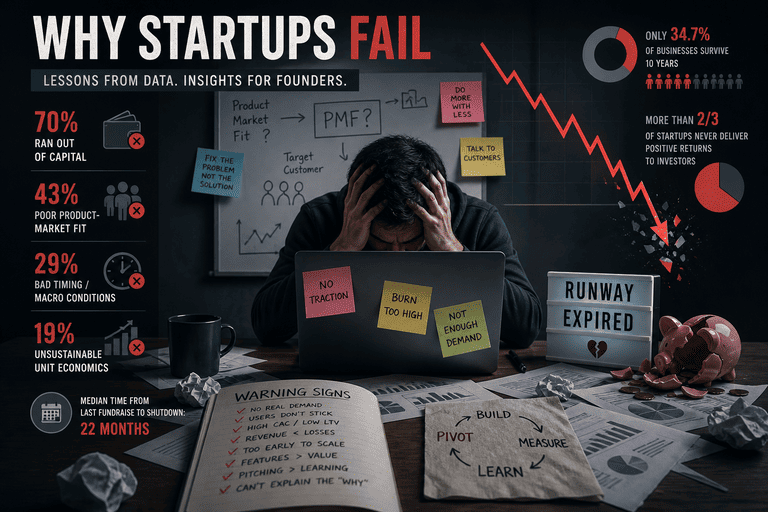
Failure is common. CB Insights’ analysis of 431 VC-backed startup shutdowns found that 70% ran out of capital, 43% had poor product-market fit, 29% had bad timing, and 19% had unsustainable unit economics. That tells us something important: money problems are often a symptom, not the disease.
Broader business data shows the same pattern of early risk. According to the U.S. Bureau of Labor Statistics, only 34.7% of U.S. private-sector business establishments born in 2013 were still operating ten years later, and the biggest drop happened in the first year. In that cohort, survival fell by 20.4 percentage points after year one. This is not startup-only data, but it is a useful reminder that early-stage businesses are fragile.
Harvard Business Review puts it even more bluntly: more than two-thirds of startups never deliver a positive return to investors. That does not mean success is random. It means the margin for error is small.
Statistics at a glance
- 70% of failed VC-backed startups in CB Insights’ dataset ran out of capital.
- 43% showed poor product-market fit.
- 29% failed because of bad timing or macro conditions.
- 19% had unsustainable unit economics.
- The median time from last fundraise to shutdown was 22 months.
- In BLS data, only 34.7% of business establishments survived 10 years.
- One-year survival rates for new business establishments varied by U.S. region and cycle, from 71.4% at the low end to 84.6% at the high end in the published series.
The main reasons startups fail
1. They solve a weak problem
This is the biggest one. Many founders start with an idea they like, not a painful problem customers urgently want solved. Y Combinator says founders often hold too tightly to solutions and too loosely to problems. That is backwards. Strong startups start with a problem that feels urgent to the customer.
A good test is simple: if your product disappeared tomorrow, would customers actively try to get it back, or would they shrug and move on? If the answer is the second one, you probably do not have strong enough demand.
2. They mistake interest for product-market fit
A few pilot users, a seed round, or social media buzz do not mean product-market fit. Y Combinator warns that founders often think they have it too early, then hire fast, increase burn, and optimize the wrong product. Real product-market fit looks like growing usage, loyal users, and customers buying as fast as you can support them.
This is where many startups get trapped: they see signs of life, but not real pull. Early noise is not the same as repeatable demand.
3. They run out of cash because the business does not work yet
Running out of money is often the last chapter, not the first mistake. CB Insights found that 70% of failed startups ran out of capital, but the more revealing causes were poor product-market fit, timing, and weak unit economics.
If customer acquisition is expensive, retention is weak, and each sale loses money, more funding only buys time. It does not fix the model.
4. They scale before they are ready
Startups often hire too early, add features too fast, and expand channels before they have a repeatable sales motion. This creates complexity before the basics are stable. Y Combinator’s advice is to stay lean until demand is clearly real. In simple words: do not build an army when you still need a small, fast special-ops team.
Premature scaling usually creates three problems at once: higher burn, slower decision-making, and less honest learning from customers.
5. They enter the market at the wrong time
Timing matters more than founders like to admit. CB Insights found bad timing or macro conditions in 29% of failures.
A product can be good and still fail because the market is too early, too crowded, too poor, too regulated, or simply not ready to change behavior.
6. They ignore unit economics
Growth without healthy economics can look impressive for a while. Then it breaks. If each customer costs too much to acquire, takes too long to pay back, or never becomes profitable, the company is moving in the wrong direction even while revenue rises. CB Insights identified unsustainable unit economics in 19% of failed startups.
This is why “grow first, fix later” is dangerous unless you are very sure your margins improve with scale.
7. The team makes avoidable execution mistakes
Harvard Business Review argues startup failure is not just about the “horse” or the “jockey”; it can be about how founders match opportunity, timing, and execution. In plain language, even smart teams fail when they choose the wrong market, chase the wrong customers, or respond too slowly when reality changes.
Good founders are not the ones who never make mistakes. They are the ones who notice mistakes early and change course fast.
Practical warning signs founders should not ignore
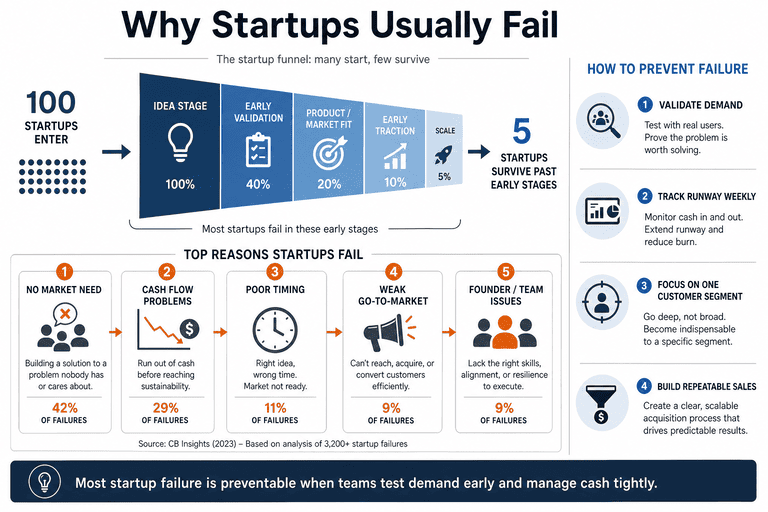
- Customers say your product is “interesting,” but do not buy.
- Users try it once, then disappear.
- You need heavy discounts or constant manual support to close deals.
- Revenue grows, but losses grow faster.
- Your roadmap is full of features, but retention is flat.
- You hire because investors expect growth, not because the system is working.
- Your team spends more time pitching than talking to customers.
- You cannot clearly explain why one customer segment truly needs the product.
If several of these are true at once, the startup is likely not failing from “bad luck.” It is failing from weak foundations.
A practical table: failure pattern, what it looks like, and what to do
| Failure pattern | What it looks like in real life | Why it happens | Practical fix |
|---|---|---|---|
| No strong market need | Users like demos but do not buy or return | The problem is not urgent enough | Interview users weekly, focus on one painful use case, cut non-core features |
| Fake product-market fit | A few pilots or hype are treated as proof | Founders confuse interest with pull | Track retention, repeat purchase, referrals, and speed of sales cycles |
| Burn too high | Team grows faster than revenue quality | Scaling before the model works | Freeze hiring, cut experiments, protect runway, get back to core metrics |
| Bad unit economics | CAC is too high, payback is too slow, margins stay weak | Growth is not profitable | Raise prices, narrow target segment, improve onboarding and retention |
| Wrong timing | Good product, weak adoption | Market not ready or conditions changed | Reposition, target a more ready niche, find a near-term “wedge” use case |
| Weak go-to-market | Product is decent, pipeline is not | No repeatable sales or distribution engine | Pick one channel, build one repeatable playbook, measure conversion step by step |
| Founder/team issues | Slow decisions, conflict, mixed priorities | Misalignment and unclear ownership | Clarify roles, decision rights, weekly priorities, and what success means |
| Too much complexity | Too many features, segments, and experiments | Lack of focus | Choose one ICP, one product promise, one key metric |
What the best professional guides say
What Y Combinator gets right
Y Combinator’s advice is brutally practical: choose a market where users have a real, meaningful problem; launch quickly; listen closely; and stay lean until demand is undeniable. That is good advice because most early startup failure comes from building too much before learning enough.
What Sequoia Capital gets right
Sequoia’s product-market fit framework is useful because it reminds founders that not every startup wins in the same way. Some products solve a “hair on fire” urgent problem. Others challenge a “hard fact” customers have accepted for years. Others are a “future vision” that needs time and intermediate commercial steps. One big mistake, Sequoia says, is forcing your startup into the wrong path. Another is being too early and not finding practical “pit stops” on the way.
What Harvard Business Review gets right
HBR’s core lesson is that failure is usually a pattern, not a single event. Startups often collapse after a series of small strategic mistakes: wrong assumptions, weak feedback loops, bad customer selection, and slow correction. That is useful because it means founders should build systems for learning, not just systems for growth.
A simple anti-failure checklist
Use this before you scale anything:
- Define one clear customer segment.
- Write the top 3 painful problems that segment already pays to solve.
- Test with a simple MVP, not a polished full product.
- Talk to users every week.
- Measure retention, not just signups.
- Track runway every week.
- Know your CAC, gross margin, and payback period.
- Delay big hiring until demand is repeatable.
- Pick one growth channel before adding more.
- Cut features that do not improve conversion or retention.
This is boring advice. That is exactly why it works.
If you are a founder, focus on these 5 questions every month
- Who urgently needs this now?
- What proof do we have beyond opinions and vanity metrics?
- Are customers coming back, paying more, or referring others?
- If growth doubled next month, would our economics improve or get worse?
- What is the single biggest assumption that could kill this company?
Most startups fail because they stop asking hard questions too early.
FAQ
Why do startups usually fail even with funding?
Because funding can hide problems for a while. A startup may look healthy after a raise, but if customers do not really need the product or the economics do not work, cash only delays the outcome. CB Insights found that running out of capital was common, but weak product-market fit and poor economics explained why that happened.
What is the number one reason startups fail?
The most common root cause is weak product-market fit. In simple terms, the product is not solving a strong enough problem for a large enough group of customers. CB Insights reported poor product-market fit in 43% of the failed startups it analyzed.
Can a great team still fail?
Yes. Strong teams still fail when they choose a weak market, scale too early, or ignore bad feedback. Execution matters, but it cannot fully compensate for poor demand or bad timing.
Do startups fail because of competition?
Sometimes, but competition is often not the real issue. The deeper issue is usually lack of differentiation, weak positioning, or solving a problem that is not painful enough. In strong markets, customers pull good products in quickly.
How can founders reduce the chance of failure?
Start lean, test demand early, talk to customers constantly, track unit economics, and scale only after you see repeatable traction. This matches the advice from Y Combinator and Sequoia: solve a real problem, understand your market path, and avoid pretending demand is stronger than it is.
Is failure always bad?
Not always. A fast, honest failure can save years of wasted effort and capital. The real danger is not failure itself. The real danger is slow failure that looks like progress.
Conclusion
Most startup failure is not mysterious. Startups usually fail because they build before they validate, spend before they fit, and scale before they are ready. The good news is that these are fixable habits. Founders who stay close to customers, keep burn under control, and treat product-market fit as something to prove rather than assume give themselves a much better chance of surviving long enough to matter.