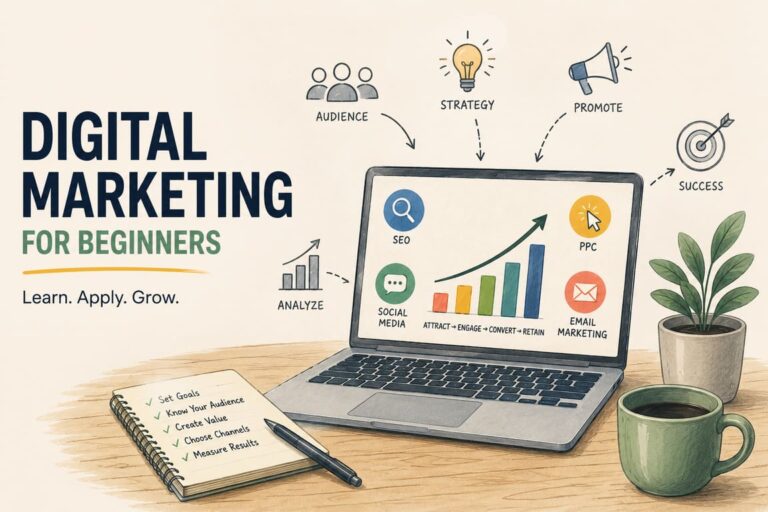
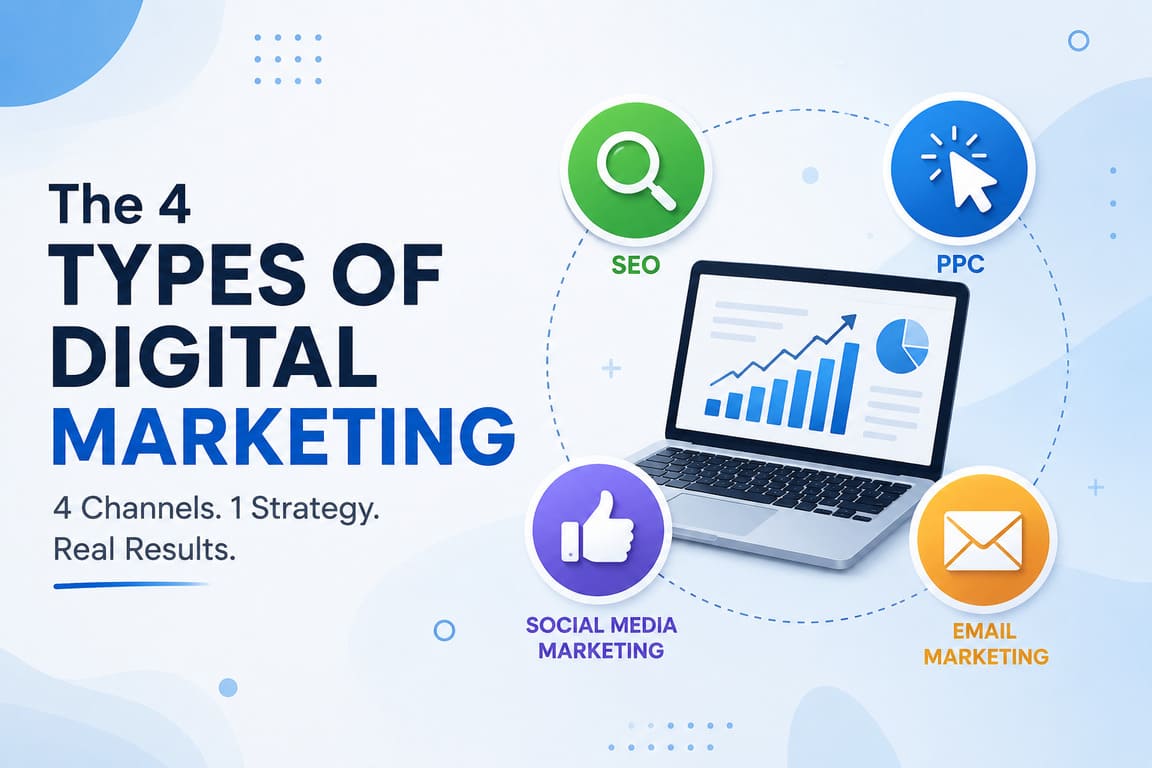
Digital marketing is a big field, but if you want a simple and practical way to understand it, start with these 4 core types:
- Search Engine Optimization (SEO)
- Pay-Per-Click Advertising (PPC)
- Social Media Marketing
- Email Marketing
These four channels cover the full customer journey: getting found, buying attention, building trust, and bringing people back.
If you are a beginner, the best approach is not to do everything at once. It is to understand what each channel does best, why it works, what results it can bring, and how to use it in a smart, low-risk way.
The 4 Types of Digital Marketing at a Glance
| Type | Main Goal | Best For | Speed of Results | Cost Structure | Biggest Strength |
|---|---|---|---|---|---|
| SEO | Get free organic traffic from search engines | Long-term growth, lead generation, authority | Slow to medium | Time + content + optimization | Compounds over time |
| PPC | Get instant traffic through paid ads | Fast leads, product launches, testing offers | Fast | Pay for clicks | Immediate visibility |
| Social Media Marketing | Build attention, trust, and community | Brand awareness, engagement, word-of-mouth | Medium | Organic time or paid promotion | Strong audience connection |
| Email Marketing | Turn attention into repeat sales and leads | Retention, nurture, reactivation, upsells | Medium to fast | Low platform cost | High control and ROI |
Why these 4 channels matter together
A strong digital strategy usually does not rely on one tactic. It works like this:
- SEO brings people who are actively searching
- PPC gets you traffic right away
- Social media helps people notice, trust, and remember you
- Email helps you convert and retain the people you already reached
In other words, these are not competing channels. They are a system.
1) Search Engine Optimization (SEO)
What SEO is
SEO is the process of helping your website appear in search engine results when people look for topics, products, or services related to your business.
Example:
If you sell accounting software, you want to appear when people search for terms like:
- “best accounting software for freelancers”
- “how to track expenses for small business”
- “invoice tool for consultants”
Why SEO works
SEO works because it captures existing intent.
People are already looking for answers. If your page matches their need, you can earn traffic without paying for every click.
That is why SEO often brings high-quality visitors. These users are not being interrupted. They are already interested.
A strong reason to invest in SEO is that the top positions get a very large share of clicks. The #1 organic result gets an average 39.8% CTR, and the top 3 results receive 68.7% of clicks. The #1 organic result also gets 19x more clicks than the top paid search result.
What results SEO can bring
SEO can help you get:
- steady website traffic
- cheaper leads over time
- stronger brand authority
- better conversion intent
- long-term growth that keeps working after content is published
HubSpot also notes that, for B2B brands, website, blog, and SEO efforts were the top ROI-driving channel in 2024.
Real-world example: American Express OPEN Forum
American Express built OPEN Forum to improve SEO and attract business owners through expert-led content. According to Adobe’s campaign roundup, it became the company’s top lead source for new card members. Source
Why this worked
It did not just publish random blog posts. It created a useful content hub around real business problems. That helped American Express:
- rank for relevant searches
- build trust through expert content
- attract the right audience before the sales conversation started
Beginner playbook for SEO
If you are just starting, do this:
- Pick 10 high-intent questions your customers ask
- Create one clear page or article for each question
- Put the main keyword in:
- title
- URL
- first paragraph
- subheadings
- Add examples, screenshots, or simple step-by-step help
- Make sure the page loads well on mobile
- Link related pages together
Best professional tip
Do not chase only high-volume keywords. Start with specific, lower-competition topics that show buying or problem-solving intent.
Good beginner keyword examples:
- “best CRM for real estate agents”
- “how to choose running shoes for flat feet”
- “email marketing software for nonprofits”
2) Pay-Per-Click Advertising (PPC)
What PPC is
PPC is digital advertising where you pay when someone clicks your ad. The most common example is Google Ads, but PPC also includes paid social and other paid placements.
Example:
When someone searches “emergency plumber near me,” the top sponsored results are PPC ads.
Why PPC works
PPC works because it buys immediate visibility.
You do not have to wait months for rankings. You can show up today if your targeting, ad copy, and landing page are good.
This makes PPC useful for:
- new businesses
- limited-time promotions
- local service companies
- testing offers fast
- generating leads while SEO is still growing
What results PPC can bring
According to WordStream’s 2025 Google Ads benchmark report, the average Google Ads metrics across industries were:
- CTR: 6.66%
- CPC: $5.26
- Conversion rate: 7.52%
- Cost per lead: $70.11
That does not mean every business will get those numbers, but it shows something important: PPC can drive measurable action quickly when managed well.
Why PPC sometimes fails
PPC usually fails for beginners for one of three reasons:
- they target broad, low-intent keywords
- their ad promise does not match the landing page
- they send traffic to a weak page with no clear offer
WordStream specifically recommends focusing on high-intent transactional terms, using ad assets, auditing campaigns regularly, and improving the landing page experience.
Beginner playbook for PPC
Start small and controlled:
- Pick one offer
- Pick one audience
- Use high-intent keywords
- Write ads that match the exact search
- Send traffic to one focused landing page
- Track:
- clicks
- leads
- cost per lead
- conversion rate
Best professional tip
Do not launch 20 keywords on day one.
Start with a tight group of highly relevant searches. Small, focused campaigns are easier to improve.
Simple example
Bad keyword: “marketing”
Better keyword: “email marketing agency for Shopify stores”
The second term is clearer, more commercial, and more likely to convert.
3) Social Media Marketing
What social media marketing is
Social media marketing is the use of platforms like Instagram, Facebook, TikTok, LinkedIn, and YouTube to build attention, trust, engagement, and demand.
It includes:
- organic posts
- short-form videos
- community management
- creator collaborations
- paid boosts and campaigns
- user-generated content
Why social media works
Social media works because people trust people, stories, and proof more than polished corporate messages.
It is one of the best channels for:
- brand discovery
- social proof
- emotional connection
- community building
- repeated exposure
HubSpot reports that Instagram is used by 70% of marketers, 43% of marketers rank Facebook as one of the highest ROI-driving social platforms, and 32% say TikTok consistently offers the highest ROI. Source
What results social media can bring
Done well, social media can bring:
- more brand awareness
- engaged followers
- referral traffic
- lower-cost reach through shares and UGC
- trust before the sale
- better retargeting performance later
Real-world example: Airbnb – “Made Possible by Hosts”
Adobe notes that Airbnb’s Made Possible by Hosts campaign used user-generated content and reached 17 million views across Airbnb platforms. The campaign supported both host acquisition and bookings.
Why this worked
Airbnb did not rely on generic travel ads. It used real experiences and real people. That made the content feel:
- authentic
- emotional
- shareable
- easy to trust
Real-world example: Dove – “Project #ShowUs”
Dove created a campaign centered on representation and diverse visual storytelling. Adobe reports that the campaign achieved 100% positive brand sentiment.
Why this worked
It connected the brand to a bigger mission, not just a product. Social media responds strongly when brands combine:
- identity
- visual storytelling
- cultural relevance
- community values
Beginner playbook for social media
If you are new, keep it simple:
- Choose one main platform
- Pick 3 content pillars
- education
- proof
- personality
- Post consistently
- Use real customer language
- Reply to comments and messages
- Track saves, shares, clicks, and leads
Best professional tip
Do not post only promotions.
A good beginner mix is:
- 50% useful content
- 30% trust-building content
- 20% direct offer content
4) Email Marketing
What email marketing is
Email marketing is the practice of sending targeted messages to subscribers, leads, or customers.
It is used for:
- newsletters
- promotions
- welcome sequences
- abandoned cart reminders
- lead nurturing
- upsells and retention
Why email works
Email works because you own the audience relationship more than on social platforms.
You are not depending on a feed algorithm to reach people.
It is also highly effective because it supports timing and personalization. You can send different messages to different people based on:
- what they downloaded
- what they viewed
- what they bought
- whether they opened earlier emails
What results email can bring
Forbes reports that email marketing generates about $36 for every $1 spent. It also notes:
- personalized emails can increase open rates by 26%
- 41% of email views come from mobile devices
- automated flows can generate up to 30x more revenue per recipient
- personalization can produce 6x higher transaction rates
HubSpot adds that:
- segmented emails drive 30% more opens and 50% more clicks
- 78% of marketers say segmentation is their most effective email strategy
- email marketing conversion rate is 2.8% for B2C and 2.4% for B2B
Real-world example: UNIQLO – “Uncover”
Adobe reports that UNIQLO’s omnichannel campaign generated:
- 1.3 million video views
- 25,000 newsletter subscribers
- 35,000 new customers Source
Why this worked
The campaign did not stop at awareness. It captured contact information and kept nurturing people after the first interaction. That is the real strength of email: it turns attention into a repeatable system.
Beginner playbook for email marketing
Start with these 4 emails:
- Welcome email
Tell people who you are and what they should expect. - Value email
Teach something useful. - Proof email
Share a testimonial, case, or result. - Offer email
Make a clear call to action.
Best professional tip
If you do only one advanced thing early, do segmentation.
At minimum, separate:
- new leads
- active customers
- inactive subscribers
That alone can improve results more than writing more emails.
Table 2. Beginner Action Plan: How to Apply the 4 Types in Practice
| Channel | First 30-Day Goal | First Action | What to Measure | Common Beginner Mistake |
|---|---|---|---|---|
| SEO | Publish useful pages that match real search intent | Create 4 articles or landing pages around customer questions | Organic clicks, rankings, time on page, leads | Writing broad content with no clear keyword intent |
| PPC | Validate one offer fast | Launch one small campaign with tight keyword targeting | CTR, conversion rate, cost per lead | Sending traffic to the homepage |
| Social Media | Build trust and consistency | Publish 3 posts per week around one audience problem | Reach, saves, shares, profile visits, clicks | Posting only sales content |
| Email Marketing | Build a basic nurture system | Create a signup form + 4-email welcome sequence | Open rate, click rate, replies, conversions | Sending the same message to everyone |
Key Statistics That Matter
Here are the numbers worth remembering:
- The #1 organic Google result gets an average 39.8% CTR.
- The top 3 organic results capture 68.7% of clicks.
- The average Google Ads CTR in 2025 was 6.66%, with an average conversion rate of 7.52%.
- Email marketing returns around $36 for every $1 spent.
- Segmented emails drive 30% more opens and 50% more clicks than unsegmented emails.
- 70% of marketers use Instagram, and 43% rank Facebook as a top ROI-driving social platform.
Text Infographic: How the 4 Types Work Together
          DIGITAL MARKETING SYSTEM

     PEOPLE SEARCHING            PEOPLE BROWSING
            |                          |
            v                          v
        [ SEO ]                    [ SOCIAL ]
   Get discovered             Build attention + trust
            |                          |
            +-----------+--------------+
                        |
                        v
                     [ PPC ]
          Buy fast traffic to tested offers
                        |
                        v
                 LANDING PAGE / OFFER
                        |
                        v
                    [ EMAIL ]
         Follow up, nurture, convert, retain
                        |
                        v
                 REPEAT SALES + LOYALTY
5 Professional Rules That Make These Strategies Work
1. Match the channel to the goal
Use SEO for long-term demand, PPC for speed, social for attention, and email for conversion and retention.
2. Start with customer intent
Do not begin with “What do I want to post?”
Begin with “What is my customer trying to solve?”
3. Keep the message consistent
The promise in your ad, post, article, or email should match the landing page.
4. Measure one layer deeper
Do not stop at vanity metrics like likes or impressions. Measure:
- leads
- sales
- cost per lead
- customer quality
- repeat purchases
5. Build systems, not random campaigns
The best results come when channels support each other.
For example:
- SEO article brings the click
- email form captures the lead
- social retargeting keeps attention
- email closes the sale
Short Case Study Roundup
1. American Express: content + SEO authority
What happened: OPEN Forum became a major lead source.
Why it worked: Expert-led content answered real business questions and built authority.
2. Airbnb: user-generated social storytelling
What happened: 17 million views across platforms.
Why it worked: Real stories are more believable and shareable than brand-only creative.
3. UNIQLO: campaign to subscriber pipeline
What happened: 25,000 newsletter subscribers and 35,000 new customers.
Why it worked: It connected campaign excitement to ongoing customer communication.
4. Dove: social mission with visual relevance
What happened: 100% positive brand sentiment.
Why it worked: It aligned brand message, social values, and visual storytelling.
5. Slack: social proof at scale
What happened: Adobe links Slack’s word-of-mouth approach to growth beyond 8 million active daily users.
Why it worked: Customer praise became marketing content.
Which Type Should Beginners Start With?
The smartest order for most beginners is:
- Email marketing if you already have traffic or customers
- SEO if you want long-term growth
- PPC if you need leads quickly and can track results
- Social media if your niche depends on trust, visuals, or community
But if you are starting from zero, a simple combo works best:
- 1 SEO article per week
- 3 social posts per week
- 1 small PPC test
- 1 email signup offer + welcome sequence
That is enough to build momentum without getting overwhelmed.
FAQ
What are the 4 main types of digital marketing?
A practical beginner-friendly framework includes SEO, PPC, social media marketing, and email marketing. These four cover discovery, acquisition, engagement, and retention.
Which type of digital marketing is best for beginners?
Email and SEO are often the safest starting points. Email is low-cost and strong for conversion. SEO is slower, but it builds long-term traffic.
Which type gets results the fastest?
PPC usually gets the fastest results because you can pay for immediate visibility. But fast traffic does not always mean profitable traffic.
Which type gives the best long-term ROI?
SEO and email usually perform very well over time. HubSpot reports strong ROI from website/blog/SEO for B2B and from email marketing for B2C. Source
Do small businesses need all 4 types?
Not at the start. A small business can begin with 1 or 2 channels. What matters is choosing the channels that fit the business model and customer behavior.
How long does digital marketing take to work?
- PPC: often fast
- Email: medium to fast
- Social: medium
- SEO: slowest at first, but strongest over time when done well
Can I do digital marketing without a big budget?
Yes. SEO, organic social, and email can all start small. Budget helps, but clarity, consistency, and good messaging matter more than many beginners think.
Final Takeaway
If you remember only one thing, remember this:
- SEO helps people find you
- PPC helps people reach you fast
- Social media helps people trust you
- Email helps people buy and come back
That is why these are the 4 most practical types of digital marketing for beginners and growing businesses alike.
The best strategy is not to master all of them at once.
It is to start with one clear goal, one audience, one offer, and one channel—then build from there.