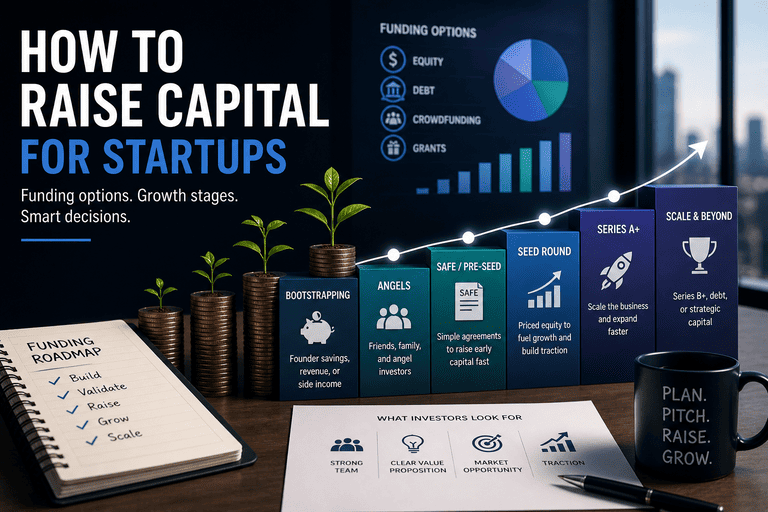
To understand how startups raise money, forget the movie version where one perfect pitch solves everything. In real life, most founders move step by step: personal savings, revenue, angels, SAFEs, priced equity, debt, or crowdfunding, depending on how much proof the business already has. The best founders do not chase capital first; they build enough evidence that capital becomes easier to get. Source
If you want to know how to raise capital for startups, use one simple rule: match the financing method to the milestone you need to reach next. If you only need time to build an MVP, you probably need a small, fast round. If you have product-market fit and strong growth, you can justify a larger institutional round. If cash flow is predictable, debt may be better than selling equity.
Startup funding path at a glance
CopyIDEA
  ↓
Founder savings / side income / consulting
  ↓
Prototype or MVP
  ↓
Friends, family, angels, accelerator
  ↓
Early traction
  ↓
SAFE or small seed round
  ↓
Repeatable growth
  ↓
Priced seed / Series A
  ↓
Scale
  ↓
Series B+, venture debt, strategic capital
The practical playbook
- Pick one milestone that unlocks the next round
Do not try to raise funds before you can explain what this money will prove: launch the product, get 100 paying customers, reach $50k MRR, or expand into a second market. - Work backward from runway
Estimate monthly burn, then add enough runway to hit the milestone plus a cushion. A common planning window is roughly 12 to 24 months, depending on stage and market conditions. - Choose the simplest instrument that fits the stage
Early rounds are often done with a SAFE because it is faster. Later rounds are often priced because larger checks usually come with governance and valuation negotiations. - Build a short investor-ready package
You need a sharp deck, a simple financial model, a clear story on why now, and proof that customers want the product. - Target the right investors, not all investors
Build a list by stage, geography, sector, and check size. A strong fit matters more than a famous logo. - Run the process tightly
Talk to investors in a concentrated window, not over six random months. Momentum matters. - Close fast once you get a yes
Verbal interest is not cash. Reduce delays, use standard docs, and get signatures and wires done quickly. Source
Funding options compared
| Funding source | Best stage | Main advantage | Main cost | Good fit when | Main risk |
|---|---|---|---|---|---|
| Bootstrapping | Idea to early traction | Full control | Your own cash and time | You can build cheaply or sell early | Slow growth, personal financial risk |
| Friends, family, angels | Pre-seed | Fast access to first capital | Equity or informal expectations | You need a small first check | Relationship stress, messy terms |
| SAFE | Pre-seed / Seed | Fast, simple, low legal friction | Future dilution | You need speed and flexibility | Founders underestimate dilution |
| Priced equity round | Seed / Series A+ | Clear valuation and lead investor commitment | More negotiation, more legal work | You have traction and investor demand | Longer process, more control terms |
| Venture debt / SBA-backed loan | Usually post-revenue | Avoids dilution | Repayment and covenants | Cash flow is visible and stable | Debt can hurt if growth stalls |
| Crowdfunding | Consumer products / community brands | Access to many small backers | Platform, marketing, compliance | Your product has public appeal | Public failure, campaign overhead |
In practice, SAFEs are usually easier to close than priced rounds, while loans work better for businesses that can actually repay them. Crowdfunding can help, but it is not “free internet money”; it brings platform, disclosure, and execution work.. Source
What each option really means
1) Bootstrapping
The best money for startups is often customer revenue, founder savings, or profitable services, because it keeps ownership in the hands of the team. This path is slower, but it gives founders leverage later because they are not desperate.
2) Angel money
Angels are useful when you need your first outside validation. A good angel gives speed, introductions, and pattern recognition. A bad angel gives opinions without follow-on value. Keep early terms clean and expectations realistic.
3) SAFEs
SAFEs became popular because they are simpler than notes and faster than priced rounds. For many early companies, that is exactly what you want. The trap is raising too many SAFEs at low caps and only later discovering how much ownership you gave away.
4) Priced rounds
A priced round makes sense when there is enough traction for a lead investor to set terms and valuation. It is slower, but it creates clarity around ownership, preferred stock, and board rights. This becomes more common as round size grows.
5) Debt
Not all funds for startups are venture money. Debt works best when revenue is predictable, margins are visible, and repayment is realistic. If the business is still highly uncertain, equity is usually safer than debt because missed payments can break the company.
6) Crowdfunding
Crowdfunding is strongest when buyers also become advocates. It is especially useful for consumer hardware, design-heavy products, or brands with community pull. In the U.S., equity crowdfunding is regulated and subject to offering limits, platform rules, and disclosure requirements.
Statistics founders should know
- On Carta, about 88% of pre-seed rounds in Q3 2024 were SAFEs, while only 12% were convertible notes.
- From Q4 2023 through Q3 2024, about 64% of seed rounds on Carta were SAFEs, 27% were priced equity, and about 10% were convertible notes.
- In the same Carta dataset, 42% of pre-seed investments were below $250,000, and about 73% were below $1 million.
- Crunchbase reported $91 billion in global startup funding in Q2 2025, and said H1 2025 was the strongest half-year for global venture investment since H1 2022.
- North America accounted for about 70% of global funding in H1 2025.
- NVCA and PitchBook reported $55.6 billion of U.S. VC deal value in Q2 2024, but $14.6 billion of that was concentrated in just two companies, which shows how uneven the market can be.
What this means: there is capital in the market, but it is concentrated. Small, clean, milestone-based rounds are often easier to justify than oversized rounds built on hope alone. Source
Best professional guides worth reading
- Y Combinator — A Guide to Seed Fundraising
Best for first-time founders who want a clear, operator-style fundraising process. - Y Combinator — Understanding SAFEs and Priced Equity Rounds
Best for understanding what you are actually signing and how dilution works. - Carta — Startup Funding: A Founder’s Guide to Raising Startup Capital
Best for stage-by-stage planning, equity trade-offs, and round sizing. - U.S. Small Business Administration — Fund Your Business
Best for non-VC financing options, loans, and practical startup funding basics. - SEC — Regulation Crowdfunding
Best for founders considering equity crowdfunding and needing the official rules. - U.S. Small Business Administration — Grants
Useful because it states clearly that SBA does not provide grants for starting and expanding a business.
Common mistakes
- Raising before you know what milestone the round must achieve
- Talking to the wrong investors
- Treating valuation as the only thing that matters
- Ignoring dilution from multiple SAFEs
- Taking debt too early
- Running a slow process with no urgency
- Believing grants will solve the problem
- Pitching without real customer evidence
These mistakes show up repeatedly in founder guidance because they waste time, weaken leverage, and make later rounds harder.
FAQ
How much should a startup raise?
Usually enough to reach the next meaningful milestone plus a buffer. In many cases, founders plan for roughly 12 to 24 months of runway, not an arbitrary headline number.
Should founders use a SAFE or a priced round?
A SAFE is usually better when speed and simplicity matter. A priced round is usually better when the round is larger, a lead investor is setting terms, and governance matters more.
Are grants a realistic option for most startups?
Usually not. Grants exist in some sectors, especially research and public programs, but SBA states clearly that it does not provide grants for starting and expanding a business.
When should a founder approach VCs?
After there is enough proof to support a venture-scale story: a clear market, a real customer need, early traction, and a believable path to large outcomes.
How do tech startups raise money
Most tech companies start with founder capital, angels, accelerators, or SAFEs, then move to priced seed and Series A rounds once they show traction, growth, or product-market fit. In today’s market, AI and a few hot categories attract a large share of capital, so founders outside those areas need especially strong evidence and disciplined round sizing.
Is crowdfunding a shortcut?
No. It can work well for the right product, but it requires marketing, public credibility, and legal compliance. It is a real financing channel, not an easy one.
Bottom line
Startup fundraising is not about finding one magical investor. It is about proving one thing at a time, choosing the right financing tool for that stage, and keeping the process clean, fast, and disciplined. Founders who understand milestones, dilution, and investor fit usually outperform founders who only chase the biggest possible round.