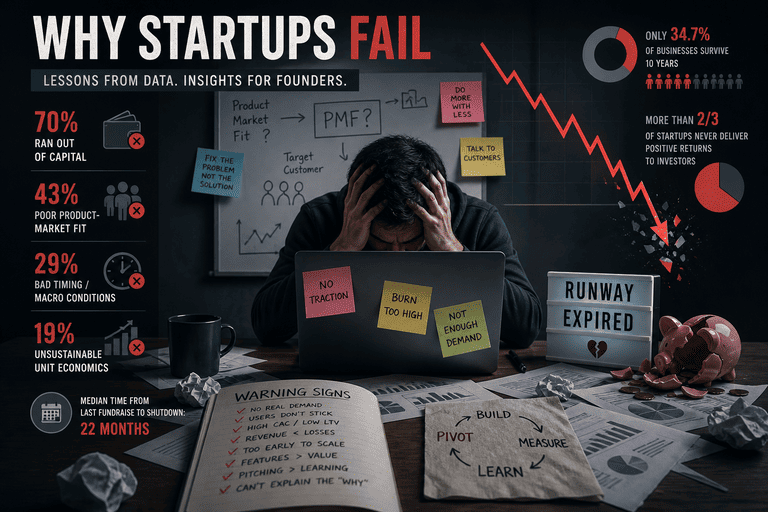
Startup investing can be exciting, but it is not easy money. Most young companies fail, exits take years, and your shares may be impossible to sell quickly. That is why startup investing should usually be a small, high-risk part of your portfolio, not the core of it. U.S. data shows that only 34.7% of private-sector business establishments born in 2013 were still operating 10 years later, which is a useful reminder that survival is hard.
If you want to start investing, begin with one simple rule: only use capital you can afford to lock up for a long time and potentially lose in full. Investor.gov warns that startup investments are speculative, illiquid, hard to value, and vulnerable to fraud.
The short answer
For most beginners, the best entry point is regulated equity crowdfunding. It is the simplest way to learn deal review, portfolio building, and risk control without jumping straight into private angel deals. Under U.S. rules, Regulation Crowdfunding offerings must be made through a registered broker-dealer or funding portal, not directly on the startup’s own site.
Many people ask, what is the best way to invest in startups? For beginners, the answer is usually: use a regulated online platform, keep your ticket sizes small, diversify across many companies, and expect a 7- to 10-year holding period or longer. That approach is usually safer than placing one big bet on a single founder.
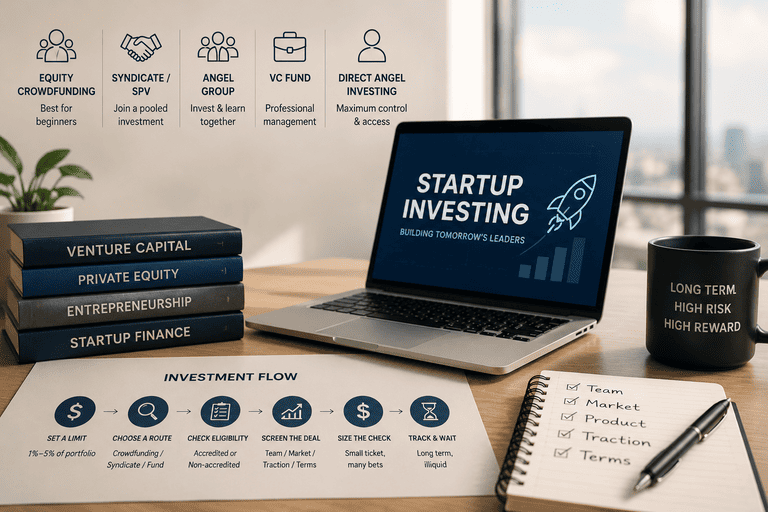
Text infographic: the smart startup investing flow
CopySET A LIMIT
1%–5% of total portfolio
        ↓
CHOOSE A ROUTE
Crowdfunding / Syndicate / Angel group / Fund
        ↓
CHECK ELIGIBILITY
Accredited or non-accredited rules
        ↓
SCREEN THE DEAL
Team → Market → Traction → Terms
        ↓
SIZE THE CHECK
Small ticket, many bets, no concentration
        ↓
TRACK & WAIT
Follow updates, expect long illiquid holding period
This simple flow matches the way professionals think: budget first, access second, due diligence third, diversification fourth, patience last.
Your main ways to invest
| Route | Who it fits | How it works | Main advantage | Main risk |
|---|---|---|---|---|
| Equity crowdfunding | Best for beginners | Invest through a regulated portal | Easy access and low friction | High failure rate, illiquidity |
| Angel syndicate / SPV | Better for experienced or accredited investors | You join a pooled vehicle for one deal | Access to curated deals and lead investors | Less control, still high risk |
| Angel group | Best for active investors | Members review deals together | Shared due diligence and learning | Time-intensive, access may be limited |
| VC fund or rolling fund | Best for investors wanting delegation | A manager builds the portfolio | Broad diversification and professional selection | Fees, lock-up, less transparency |
| Direct angel investing | Best for highly experienced investors | You invest directly into one company | Maximum control and relationship access | Highest workload and concentration risk |
An SPV is a legal vehicle created for one specific purpose; in venture, it is commonly used to pool a group of investors into one startup deal. That structure is popular because it lets smaller investors join larger rounds through a lead. AngelList
If you want to learn how to invest in startups online, equity crowdfunding is usually the easiest starting lane because the process, documents, and communication are structured on one platform. Just remember that “easy access” does not mean “low risk.”
Who can invest, and what are the limits?
In the U.S., anyone can invest through Regulation Crowdfunding offerings, but non-accredited investors have annual limits based on income and net worth. Accredited investors have no such cap under Reg CF. Companies using Reg CF can raise up to $5 million in a 12-month period.
Private angel rounds outside crowdfunding often rely on exemptions such as Regulation D and are commonly sold to accredited investors. The SEC also notes that angel investors often invest via syndicates, while VC funds are usually long-duration vehicles built to invest, monitor, and exit over roughly a decade or more.
A practical 7-step guide
1. Set a strict budget
Keep startup exposure small. For most people, that means a small satellite allocation rather than a life-changing bet. Never put emergency savings, rent, or borrowed money in startups.
2. Pick one entry route
Choose one path first instead of trying everything at once. Crowdfunding is best for learning. Syndicates are useful when you want a lead investor to source and negotiate. Funds are useful if you prefer delegation over deal-by-deal work.
3. Read the deal materials like an owner
Look for five basics: team, market, product, traction, and terms. On regulated crowdfunding deals, key information is filed in Form C and made available through the platform and SEC systems.
4. Focus on traction, not just the story
A great pitch is not enough. You want signs that customers care: revenue growth, retention, repeat purchases, pilots turning into paid contracts, or usage that keeps improving. A startup without traction may still win, but your odds are lower.
5. Understand the terms
Many beginners ignore valuation, share class, liquidation preference, dilution, and pro-rata rights. That is a mistake. A strong company can still become a weak investment if the valuation is too high or the terms are poor. Investor.gov specifically warns that private startup valuation is hard and investors can overpay.
6. Build a portfolio, not a single bet
Professional startup investors expect many losses and a few winners. That means diversification matters more here than in many other asset classes. It is usually smarter to make several smaller bets over time than one large emotional bet.
7. Plan for a long hold
This is not trading. Shares can be hard to resell, especially in the first year under crowdfunding rules, and many private investments stay illiquid much longer. If you need fast access to cash, this asset class is a bad fit.
What good startup due diligence looks like
Use this checklist before every deal:
- Founder quality — Have they built, sold, or operated in this market before?
- Market size — Is the opportunity big enough for a venture-style outcome?
- Traction — Are customers already paying, staying, and expanding?
- Unit economics — Does growth create value or just burn more cash?
- Cap table — Who owns what, and how much dilution risk is ahead?
- Terms — Common stock, preferred stock, SAFE, or convertible note?
- Lead investor quality — Is there a credible lead with skin in the game?
- Runway — How many months of cash does the company have left?
- Follow-on risk — Will the company need another round soon?
- Exit path — Is there a believable route to acquisition or IPO?
FINRA also recommends checking registration status, reading disclosures carefully, asking direct questions, verifying backgrounds, and staying alert to fraud.
Statistics every beginner should know
- Companies using Regulation Crowdfunding can raise up to $5 million in a 12-month period. SEC
- Accredited investors have no Reg CF investment limit, while non-accredited investors do have annual caps tied to income and net worth.
- Only 34.7% of U.S. private-sector establishments born in 2013 were still operating in 2023. BLS
- In Q1 2026, U.S. venture deal value reached $267.2 billion and exit value hit $347.3 billion, but the top five deals and exits heavily skewed those totals.
- The SEC says angel investors often syndicate and may pool roughly $200,000 to $400,000 per deal, while VC funds are commonly structured to last at least 10 years.
These numbers tell you something important: startup investing can produce huge winners, but the market is concentrated, outcomes are uneven, and survival odds are tough. Go in with realistic expectations.
Common mistakes to avoid
- Investing too much in one company
- Chasing hype instead of traction
- Ignoring valuation and terms
- Skipping background checks on founders and lead investors
- Using money you may need in the next few years
- Expecting quick exits
- Confusing a great product with a great investment
Most startup losses come from bad process, not bad luck alone. A disciplined checklist and small position sizes will protect you more than excitement ever will.
FAQ
How to start investing in startups
Start with a regulated crowdfunding platform, set a small budget, read at least 20 deals before buying your first one, and make your first checks small. Learn the language of SAFEs, preferred shares, dilution, and follow-on rounds before you scale up.
How to become investor in startups
In the basic sense, you become a startup investor by legally buying a private company security through a permitted route such as crowdfunding, a syndicate, an angel group, or a fund. If you want access to more private deals outside crowdfunding, you may need accredited investor status depending on the exemption being used.
How to invest in small startups
Look for very early signals of quality: founder-market fit, customer love, speed of execution, and a believable path to the next funding milestone. Be extra careful with valuation, because tiny companies can offer the highest upside and the highest failure risk at the same time.
Is crowdfunding safer than direct angel investing?
Usually it is easier for beginners, not necessarily safer. The structure is more standardized and regulated, but the underlying companies are still risky, illiquid, and speculative.
How many startups should I own?
There is no perfect number, but one or two deals is usually too concentrated. A portfolio approach is better because startup returns are driven by a few outliers. The point is not to “pick the one”; the point is to survive long enough to own a winner.
How long should I expect to wait for returns?
Usually years, not months. The SEC describes VC investing as long-horizon capital that is often locked in until an acquisition or IPO. The same mindset is useful for individual startup investors.
Final take
The best beginner strategy is simple: keep the allocation small, use regulated channels, do real due diligence, diversify aggressively, and be patient. If you treat startup investing like entertainment, you will probably lose. If you treat it like a disciplined portfolio process, you give yourself a much better chance of learning well and compounding intelligently over time.