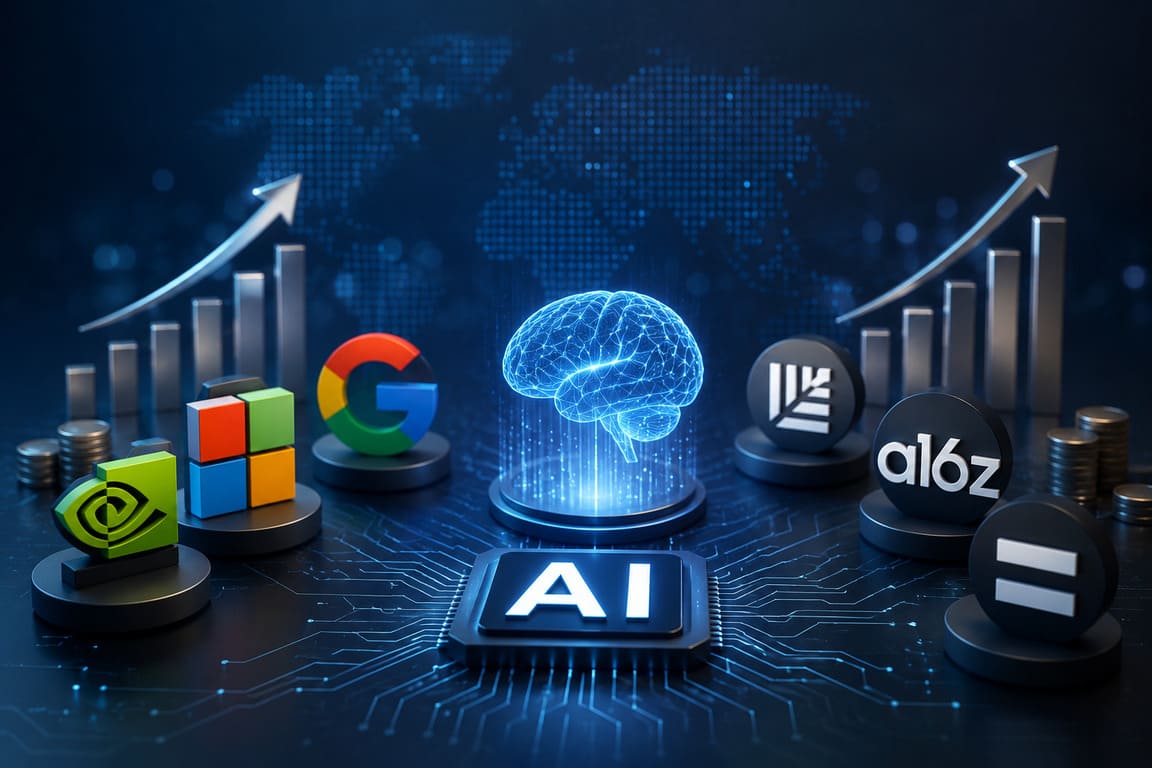
AI startup investing is now so large that “biggest investor” can mean three different things: the firms that write the largest checks, the firms that show up in the most rounds, and the firms whose name alone can help a startup hire talent, raise the next round, and win customers. The safest practical answer is this: Nvidia, Microsoft, Google/GV, Sequoia Capital, Andreessen Horowitz, and SoftBank are the clearest heavyweight names today, while firms like Y Combinator, General Catalyst, Lightspeed, Khosla, Bessemer, and Insight also matter a lot depending on stage and category.
The reason this matters is simple: AI is no longer a side market. In 2025, AI startups took $258.7 billion, or 61% of all global VC investment. The United States captured about 75% of global AI VC deal value, and North America alone saw about $168 billion go into AI-related startups, roughly 60% of all startup funding in the region.
The short answer
If you want the most practical one-line summary, here it is: Nvidia is the most visible strategic corporate investor in AI right now; Microsoft is still one of the biggest by strategic influence and check size; Google matters through both direct investments and GV; Sequoia and Andreessen Horowitz are the most important brand-name VCs in generative AI; and SoftBank stands out when round size gets extremely large.
Main investors at a glance
| Investor | Type | Why they count as “big” | Best fit for startups | Evidence |
|---|---|---|---|---|
| Nvidia | Corporate / strategic | Crunchbase says Nvidia joined 26 AI rounds totaling $18.8B in 2024, and it has outpaced Microsoft and Google in AI startup round activity. | AI infrastructure, model tooling, compute, robotics, applied AI with ecosystem value | Crunchbase |
| Microsoft | Corporate / strategic | Microsoft made 9 AI startup investments totaling nearly $10B in 2024, on top of its huge OpenAI relationship and a $1.5B strategic investment in G42. | Enterprise AI, foundational models, AI platforms, strategic partnerships | Crunchbase |
| Google + GV | Corporate + VC arm | Google itself slowed, but GV took part in 22 AI deals totaling $1.5B in 2024; Google also added $1B more to Anthropic after a prior $2B commitment. | Developer tools, infrastructure, research-heavy AI, enterprise software | Crunchbase |
| Sequoia Capital | VC | PitchBook says Sequoia kept the top spot in its generative AI investor rankings for the third year in a row. | Seed to growth, especially breakout AI application and platform companies | PitchBook |
| Andreessen Horowitz (a16z) | VC | PitchBook places Andreessen Horowitz alongside Sequoia at the top of the generative AI investor list. | Foundational AI, developer tools, infra, consumer and enterprise AI | PitchBook |
| SoftBank Vision Fund | Growth / mega-check investor | SoftBank led OpenAI’s $40B financing in 2025, making it one of the clearest examples of scale investing in AI. | Very large late-stage rounds, category leaders, model labs, infrastructure | Crunchbase |
| Databricks Ventures | Strategic corporate VC | Crunchbase says Databricks Ventures was involved in 8 AI deals in one year, including Glean and Perplexity. | Enterprise AI, data stack, search, analytics, applied AI | Crunchbase |
| Y Combinator | Accelerator / early-stage investor | PitchBook lists Y Combinator among the most active investors in AI agents. | Pre-seed and seed startups that need speed, network, and fundraising momentum | PitchBook |
What the numbers say
- AI captured 61% of all global VC funding in 2025, reaching $258.7B.
- The U.S. accounted for about 75% of global AI VC deal value in 2025, or roughly $194B.
- Deals over $100M made up 73% of all AI investment value, and $1B+ deals were nearly half the total. That means the biggest investors matter more than ever.
- In North America, AI-related startups raised about $168B, around 60% of all startup funding in 2025.
- In AI agents alone, PitchBook says VC funding reached $6.4B across 451 deals in 2025 through Oct. 13, up from $4.6B across 326 deals in 2024.
What makes these investors different
The biggest AI investors are not all playing the same game. Corporate investors like Nvidia, Microsoft, Google, and Databricks usually invest where the startup strengthens their ecosystem, fills a product gap, or increases demand for their own platforms. Top venture firms like Sequoia and a16z are looking for category leaders that can compound in value across multiple rounds. Mega-check investors like SoftBank care more about market dominance and scale than early experimentation.
That difference matters for founders. A startup building GPU-heavy infrastructure may be a much better fit for Nvidia than for a generalist seed fund. A vertical AI company with clear workflow gains may be better for Sequoia, a16z, General Catalyst, or a strong early-stage fund with enterprise software experience. And a company that already dominates its category may be ready for SoftBank-style capital, but not before.
What the best AI investors usually want
Recent investor interviews show a clear pattern. The best AI investors want startups that solve a big, painful workflow, sit on top of rich or proprietary datasets, and deliver order-of-magnitude productivity gains, not just a small feature improvement. They also care about team quality more than ever, because many AI ideas are crowded and execution now matters more than the idea alone.
They also pay close attention to distribution and growth. Crunchbase’s roundup of active AI investors noted that firms are still willing to accept premium valuations when revenue growth is unusually strong. In plain English: a cool demo helps, but fast adoption, repeat usage, and a believable go-to-market plan help more.
A practical founder guide
1. Segment your target list
Do not build one giant “AI investor” list. Split it by stage, check size, technical fit, and vertical. An investor that is perfect for an infrastructure company may be a bad fit for a healthcare AI workflow startup. OpenVC’s advice is simple and right: relevance beats quantity.
2. Match investor type to your business
If you need ecosystem help, target strategic investors. If you need brand, speed, and a strong next-round signal, target top-tier VCs. If you are raising a huge growth round, target mega-funds. Founders waste time when they pitch a late-stage capital provider for a seed-style story.
3. Lead with the workflow, not the model
Most investors have already seen hundreds of AI demos. What gets attention is a painful workflow, a clear buyer, measurable ROI, and a believable reason why your product keeps getting better over time. Sierra Ventures explicitly looks for big workflow pain, rich datasets, and large efficiency gains.
4. Show your data advantage
A startup without differentiated data or distribution is easy to copy. Investors increasingly want to know what your moat becomes after the initial model wave passes: proprietary data, user feedback loops, customer lock-in, compliance edge, deep vertical integrations, or unique infrastructure economics.
5. Prioritize warm intros
Cold outreach still works sometimes, but warm intros work much better. Use founders, angels, operators, and existing portfolio connections wherever possible. This is basic advice, but it remains one of the highest-ROI fundraising moves.
6. Prepare the metrics that matter
For early-stage AI startups, the best proof points are usually usage growth, retention, speed of deployment, cost to serve, gross margin trend, and evidence that customers trust the product in production. For later-stage startups, investors will look much harder at revenue quality and sales efficiency.
Other names worth keeping on your radar
If you are building an investor target list, do not stop at the biggest brand names. OpenVC highlights Lightspeed Venture Partners, Khosla Ventures, Bessemer Venture Partners, Insight Partners, Thrive Capital, and Cisco Investments among the notable AI-focused firms. PitchBook also highlights Pioneer Fund, General Catalyst, and Antler among the most active investors in AI agents.
Bottom line
The biggest investors in AI startups today are not one single group. Nvidia leads the strategic-corporate conversation. Microsoft remains one of the most important capital and platform players. Google matters through both direct investing and GV. Sequoia and Andreessen Horowitz are still the marquee VC names in generative AI. SoftBank stands out at the mega-round end of the market. But the practical lesson for founders is even more important: the biggest investor is not always the right investor. The right investor is the one whose stage, check size, technical understanding, and network actually match your company.
FAQ
Who is the single biggest investor in AI startups right now?
If you mean the most visible strategic corporate investor, Nvidia is the clearest answer. Crunchbase says it participated in 26 AI startup rounds totaling $18.8B in 2024, and S&P also showed Nvidia sharply ramping overall venture activity. If you mean the biggest recent single-check style investor, SoftBank’s leadership in OpenAI’s $40B financing is hard to ignore.
Are Sequoia and Andreessen Horowitz still the top VC names in AI?
Yes. PitchBook says Sequoia kept the top spot in its generative AI investor rankings, and Andreessen Horowitz also sits at the top of that list.
Should an early-stage founder pitch Nvidia, Microsoft, or Google first?
Usually not. Most early-stage founders should first target investors that match their stage and write the right check size. Corporate investors make the most sense when your startup clearly fits their strategic roadmap or ecosystem.
What do AI investors care about most right now?
The recurring themes are clear: a painful workflow, a strong team, real data advantage, measurable productivity gains, and very fast user or revenue growth. A flashy model demo alone is rarely enough.
Is AI fundraising still growing?
Yes. The latest market data shows AI taking 61% of all global VC funding in 2025, with very large rounds driving most of the value